At the fifth AIR Academic Workshop, Prof. Boxue Tian of Tsinghua’s School of Pharmaceutical Sciences presented evidence that current molecular representation models are affected by factors
At the fifth AIR Academic Workshop, Qiwei Ye of the Beijing Academy of Artificial Intelligence surveyed the demonstrated value of generative AI in the life sciences, from simulating biomolecular
At the fifth AIR Academic Workshop, AIR associate professor Hao Zhou argued that diffusion models, despite their success elsewhere, are not well suited to molecular data, and presented flow matching
At the fifth AIR Academic Workshop, AIR associate professor Jianzhu Ma described collapsing the five separate computational steps of conventional drug discovery into a single problem: given a target
The fifth AIR Academic Workshop on 14 October brought together nine speakers from Lingang Laboratory, Peking University, Tsinghua, Westlake University, Zhejiang University, BioMap and AIR. Prof.
At the fifth AIR Academic Workshop, Prof. Jianfeng Pei of Peking University’s Academy for Advanced Interdisciplinary Studies argued that because most small molecules are human-made rather than
At the fifth AIR Academic Workshop, Prof. Qiangfeng Zhang of Tsinghua’s School of Life Sciences argued that although RNA structure is generally less stable than protein structure, sufficiently stable
At the fifth AIR Academic Workshop, Chair Professor Stan Z. Li of Westlake University made the case for protein foundation models that jointly model sequence and structure, with implications
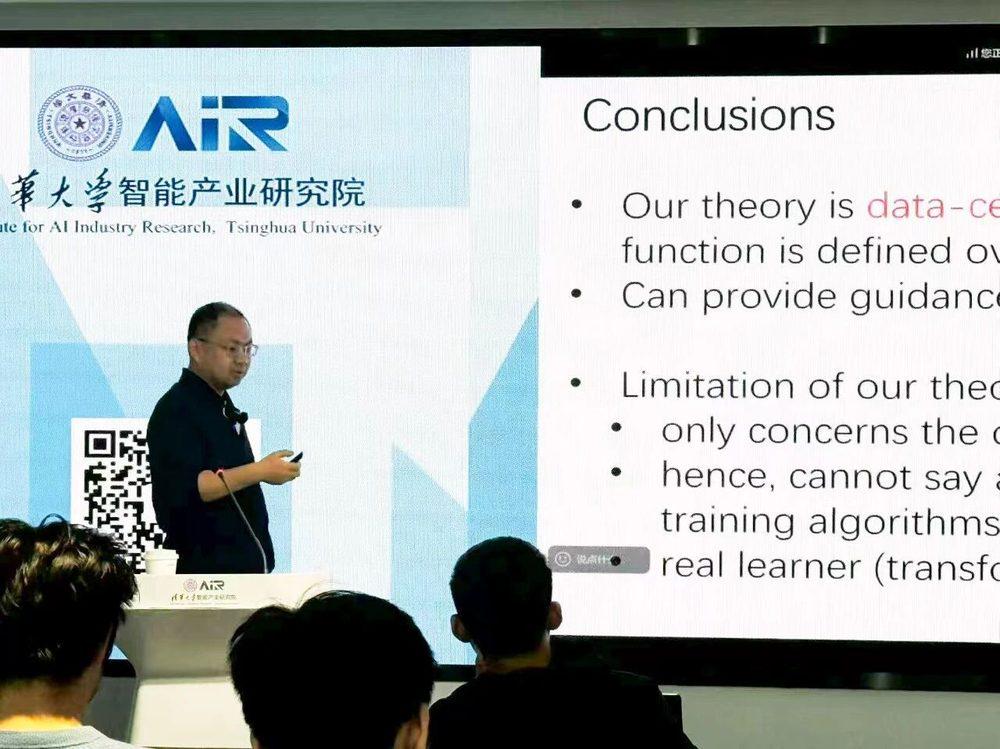
At the fifth AIR Academic Workshop, AIR professor Yanyan Lan argued that molecular representation learning for drug discovery depends on three things at once: large-scale data, objective functions
At the fifth AIR Academic Workshop on 14 October, Prof. Tingjun Hou of Zhejiang University’s College of Pharmaceutical Sciences framed molecular generation as a multi-objective optimisation problem i
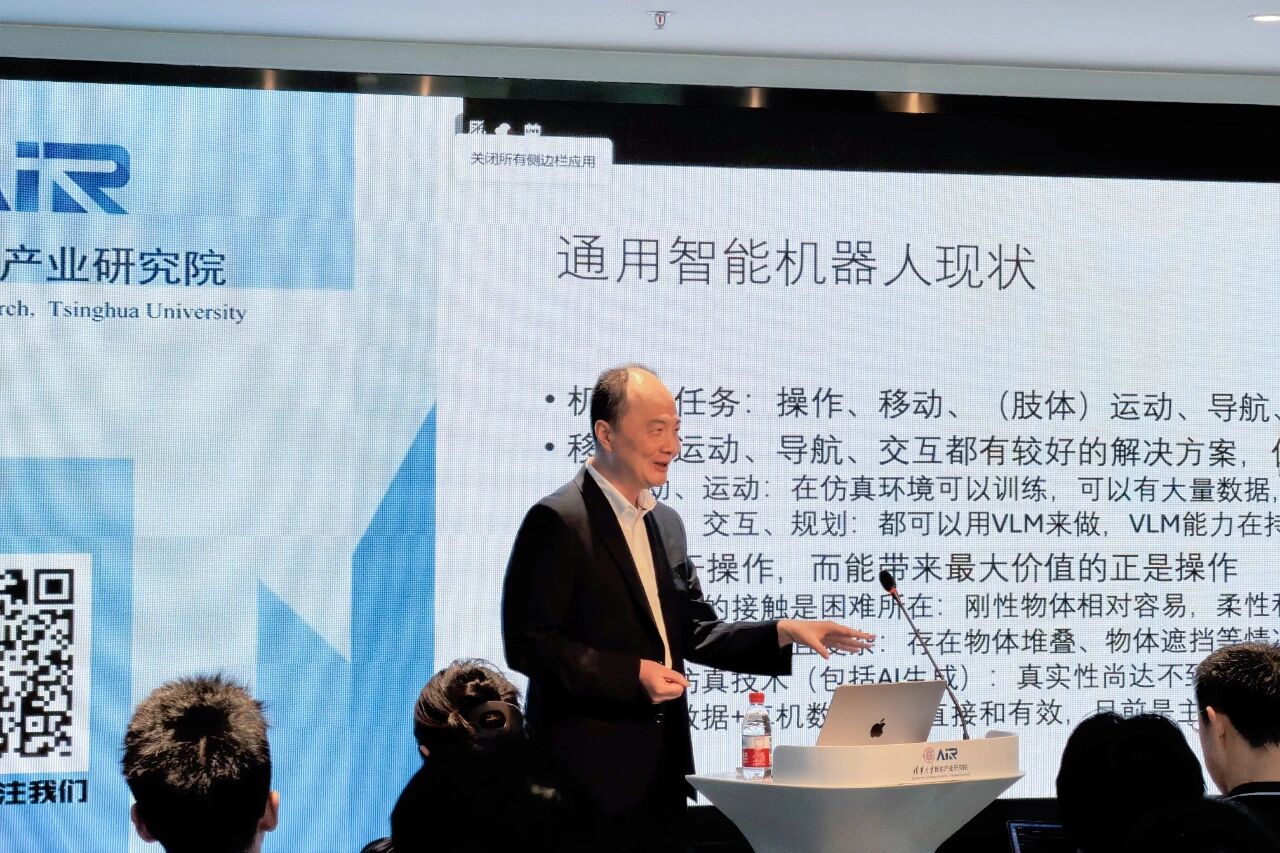
At the 23rd AIR Young Scientist Forum, assistant professor Quanming Yao of Tsinghua’s Department of Electronic Engineering examined how large language models should be adapted to tabular an
At the 22nd AIR Young Scientist Forum on 6 July, assistant professor Hao Dong of Peking University’s Center on Frontiers of Computing Studies presented object-centric policy learning as a route
AIR intern Beiwen Tian presented an unsupervised anomaly detection method for road scenes that replaces logic anchors learned from a closed training set with language anchors learned from large
AIR intern Yupeng Zheng presented STEPS, the first self-supervised framework to jointly handle low-light image enhancement and depth estimation, addressing a pairing of problems that had previously
AIR doctoral student Pengfei Li presented LODE, a method for completing 3D scenes from sparse LiDAR point clouds using locally conditioned Eikonal implicit representations, among the work AIR took
| A total of 72 First previous Next Last Total 5 pages current 3 |

Email:Airoffice@air.tsinghua.edu.cn
Tel:(010)82151160
Address:12 / F, block C, Qidi science and technology building, Tsinghua Science and Technology Park, Haidian District, Beijing

Jing ICP Bei No. 15006448 | all rights reserved@ Institute of intelligent industry, Tsinghua University